

“He simply felt that if he could carry away the vision of the spot of earth she walked on, and the way the sky and sea enclosed it, the rest of the world might seem less empty.”
― The Age of Innocence
This quote from Edith Wharton’s Pulitzer Prize-winning novel The Age of Innocence doesn’t directly appear in Martin Scorsese’s 1993 adaptation, but it doesn’t need to. As is necessary in most novels, that line makes explicit what Scorsese suggests through his cinematic canvas. Through colors and light. Through notes of Elmer Bernstein’s haunting and melancholy score. Through fiercely controlled performances boasting longing glances and terrified eyes shielding deeply hidden fears.
The Age of Innocence, to me, marks some of Scorsese’s finest hours as a filmmaker. No, not just as a filmmaker. As a true artist.
 I’ve seen The Age of Innocence dozens of times. It is to me what Citizen Kane or Vertigo or, to younger minds, Moonlight or Parasite are. It remains the perfect example of film operating on all cylinders, telling a deceptively simple story in ways that continue to astound me. When I first saw it in my freshman year at college, I had an intensely physical reaction to it. The film closes with Bernstein’s score playing Newland Archer (Daniel Day-Lewis) away from the Parisienne courtyard where he refuses to see Countess Ellen Olenska (Michelle Pfeiffer), and that moment hit me as surely as someone punched me in the stomach. Reeling from the experience, I knew I’d just connected with the film in a new and totally foreign way. Perhaps the closest thing I could imagine would be when my father took me to see Spielberg’s ET in 1982. I screamed and cried loudly through the whole thing, and he swore he’d never take me to the movies again. He didn’t follow through on that promise, but I hadn’t had such a visceral reaction to a film until years later with The Age of Innocence.
And I haven’t connected with a film like that since.
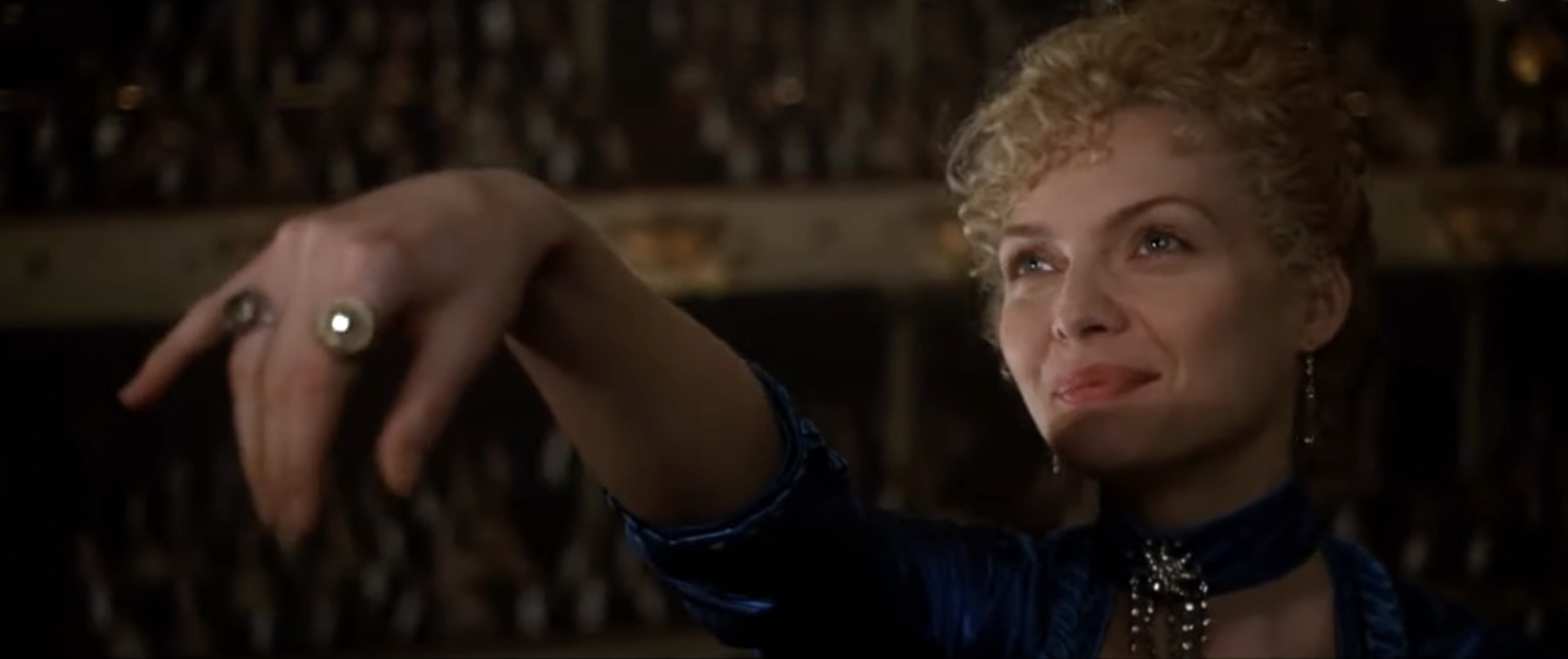
Set in the early Gilded Age of New York in the 1870s, The Age of Innocence offers a portrait of the American free world snared by tradition and unwritten customs. As Pfeiffer’s Ellen so rightly puts it, “It seems stupid to discover America only to make it a copy of another country. Do you think Christopher Columbus would have taken all that trouble just to go to the opera with Larry Lefferts?” Unafraid to speak her mind and naïve of the impact of doing so, Ellen comes home to her New York family to escape an emotionally abusive European marriage. On reconnecting with Day-Lewis’s newly engaged Newland Archer, the pair find their attraction immediate and palpable. He sees her as an escape from the mundanity of New York society, and she finds him to be warm, kind, and (perhaps amusingly) inexperienced and naïve himself.
As society begins to push back against their relationship and take the side of his fiancée May Welland (Oscar-nominated Winona Ryder), Archer becomes increasingly conflicted, finding his emotions pulled on every side. He longs to break from tradition, to urge Ellen to obtain a scandalous divorce, and to run away with her. But he can’t. The crushing disappointment to him and to the audience is that he isn’t the free-thinking man he pretends to be. He isn’t above custom and tradition. He’s as much a slave to it as anyone living on 5th Avenue.
That reality breaks him.
Recently, preparing for this Reframe, I watched the film again. I didn’t need to. I could have written from my vivid memories, but I wanted to reconnect with it as it had been a while since I’d last seen it. My reaction changed as dramatically as my own life since I last sat with it. My wife and I are now middle-aged. We have a son in college and a daughter in high school. Our parents’ are in various states of decline. I frequently find myself lost in the melancholy of a half-lived life, and Scorsese’s film holds so much of that within it.
There’s a moment when Ellen and Newland reconnect clandestinely in Boston. It’s when they have this brilliant exchange ripped straight from the novel:
Newland: You gave me my first glimpse of a real life, and then you told me to carry on with a false one. No one can endure that.
Ellen: I’m enduring it.
Gut punch.
Shortly thereafter, Ellen leaves the scene first, and Scorsese and editor Thelma Schoonmaker quickly fade her out as Newland watches her go. Then, he too dissolves, leaving only the beautiful, empty porch. Scorsese holds the camera on the space for a heartbeat as a haunting voice sings of love on the soundtrack. The moment leapt out at me on this viewing as perhaps the truest representation of memory and of the pain memories can bring. It’s as if that last scene isn’t simply the audience watching them leave. We’re perhaps stepping into Newland’s own memory, that magic moment burned into his psyche in a painful yet dramatically necessary way.
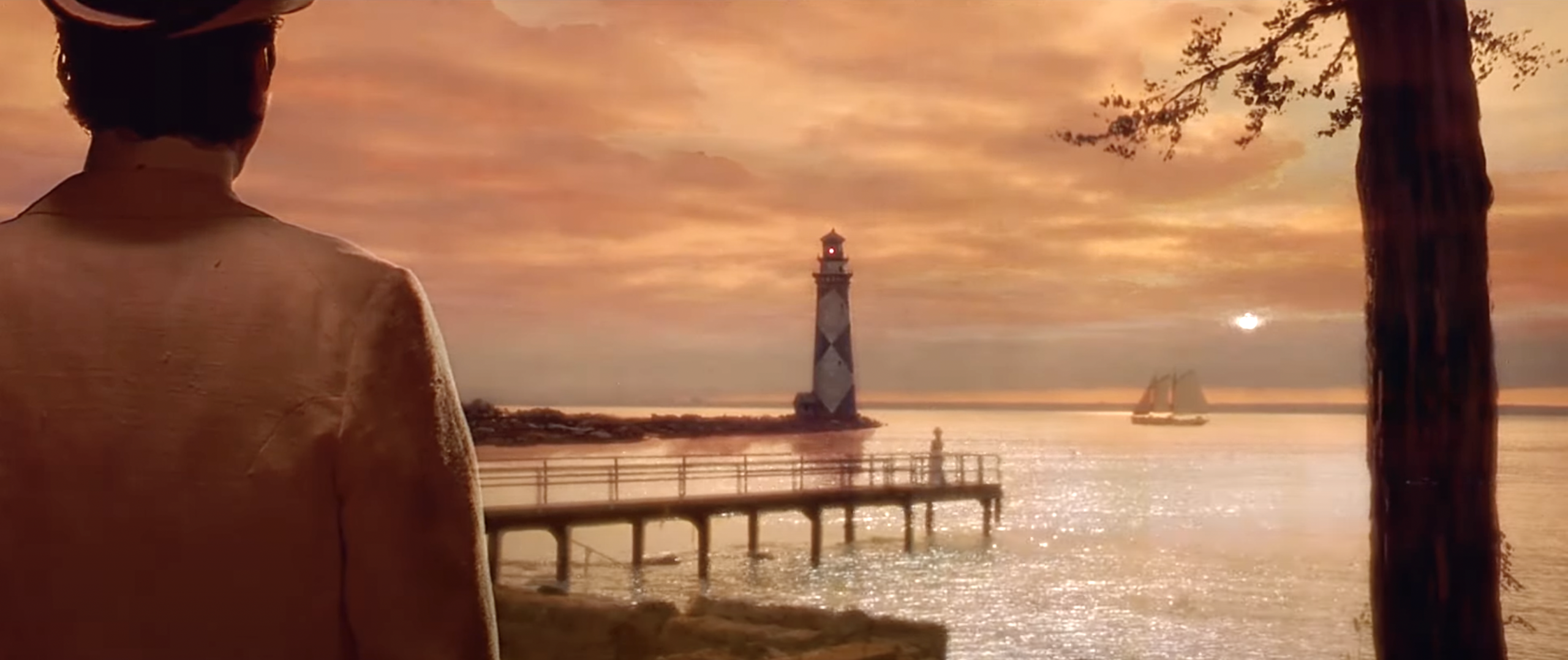
We see a similar scene at the end of the film when Newland sits on a bench outside of Ellen’s apartment in Paris. As a maid closes a window, the glass pane catches the sun, reflecting across his face and thrusting him back to the film’s most breathtaking sequence. He watches Ellen on a pier, waiting for her to turn around. In reality, she did not, and they experience another in a long series of missed connections. But in his memory, she turns around and smiles. That moment represents in an instant so many emotional beats. The blossoming of his former passion for her. The pain in realizing he was never the bold and brash man he wanted to be. The acceptance that the memory of her smile will suffice.
Before I knew it, an ending I’d seen dozens of times brought tears to my eyes. Newland says minutes before, “I’m only 57,” but I heard, “I’m only 47.” Morose? Maybe, but I broadly embrace it. Films don’t change through time, people do. As such, our reactions vary viewing after viewer, decade after decade. My new-found melancholic reaction to the film hit me nearly as strong on my 20th-odd viewing as it did the first time I’d seen it.
Who knows what it will mean to me in my 70s or 80s? I hope to live long enough to find out.
 I could go on here about the crafts, the performances, Saul Bass’s impossibly perfect opening credits, and other beautifully directed moments Scorsese offers in the film. Yet, it seemed most apt to me to share my experience watching the film as an older man. The Academy massively missed the mark on this film. It was nominated for five Oscars, winning only for Gabriella Pescucci’s exquisite costumes. Naturally, I believe it should have been nominated for far more, but it’s omission does not bother me. What the Academy thinks of a film at a given moment in history does not define its legacy. Plus, 1993 was a hugely competitive year. Not only did it have to compete against Steven Spielberg’s landmark Schindler’s List and Jane Campion’s The Piano, but it also vied against Merchant Ivory’s The Remains of the Day, a far more accessible costume drama also dealing with repression.
But, for me, Scorsese’s The Age of Innocence will forever stand apart from the period costume dramas with which it is so often compared. It is a film about repression made with intense passion by a man at the very top of his craft. Throughout the entire film, you feel Scorsese and his actors working to reign in the excitement and emotion of the piece to reflect the culture of the period. This was, as Joanne Woodward’s excellent “voice of Edith Wharton” narration says, “They all lived in a kind of hieroglyphic world where the real thing was never said or done or even thought, but only represented by a set of arbitrary signs.”
You have to study the film, to watch it in a nearly unblinking way, to really see these arbitrary signs and how Scorsese and his team of expert craftsmen tell a completely different story than is relayed through dialogue.

I hope, if you’re still with me, that you can understand how brilliant I believe this film to be, my favorite film of all time. It is in so many ways as personal to me as it must have been for Martin Scorsese when he was creating it. I don’t need Oscars to validate that. I only need eyes to drink in the unparalleled imagery, ears for Elmer Bernstein’s lush score to wash over, and a beating heart that will skip a time or two as Newland walks away from his fantasy at the bittersweet end.
And just so you don’t think I’m morbidly morose in my love of the film, I’ll include my single favorite piece of dialogue as written by Edith Wharton and included within the film by Scorsese and co-screenwriter Jay Cocks:
“It was widely known in New York, but never acknowledged, that Americans want to get away from amusement even more quickly than they want to get to it.”
I think of that every time I go to the movies.
And I smile.