

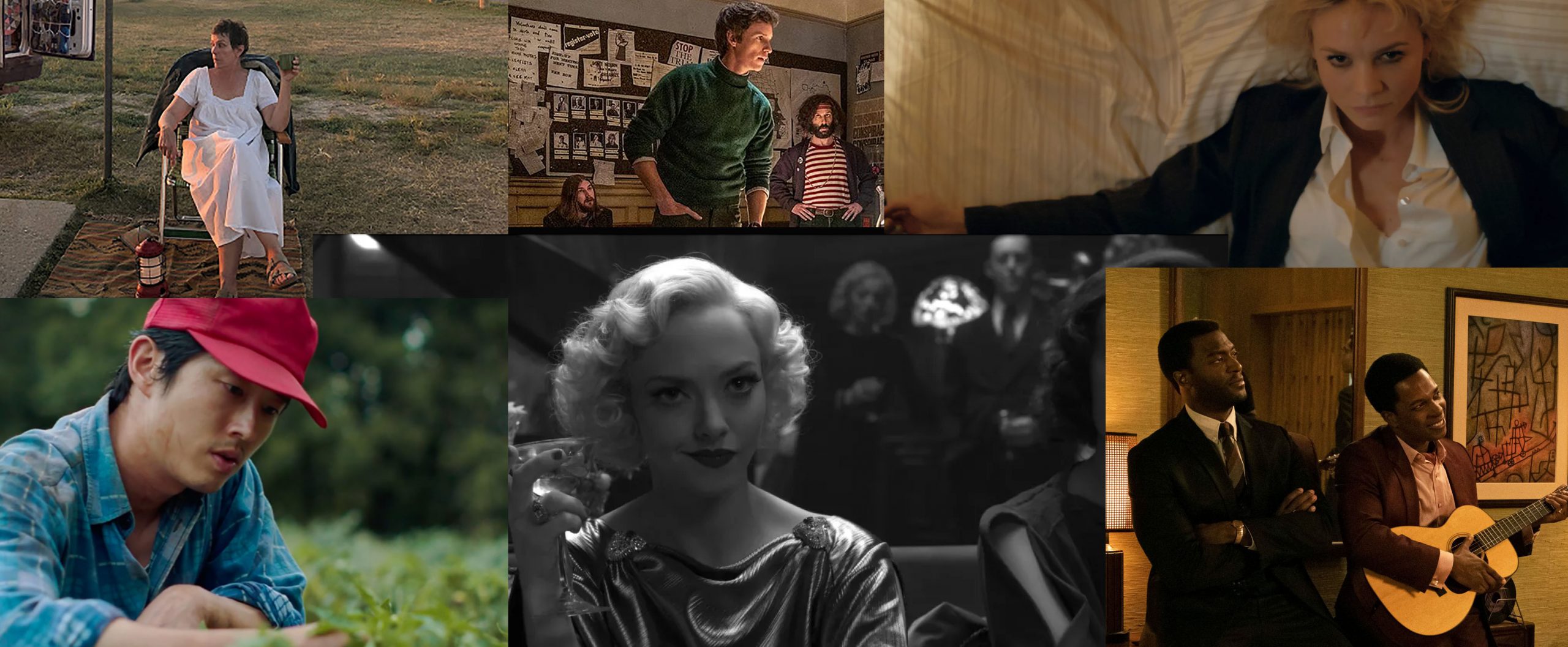
The strongest contenders for Best Director this year tell distinctly American stories, both in terms of the stories told, and in terms of those who told them. From the origins of Citizen Kane in the late 1930s to the Trial of the Chicago Seven and One Night in Miami in the 1960s, and Minari in the 1980s, and right up to the past decade when a Promising Young Woman’s life derails and a writer/director and editor aims her camera at Nomadland.
That’s David Fincher’s Mank, Aaron Sorkin’s The Trial of the Chicago 7, Lee Isaac Chung’s Minari, Regina King’s One Night in Miami, Emerald Fennell’s Promising Young Woman, and the frontrunner, Chloe Zhao’s Nomadland. These appear to be the strongest six for the moment. We need to winnow that down to five.
That might not be our final list, as there are others in the wings. They are also somehow American stories, or rather – stories about America’s complicated past. Spike Lee’s Da 5 Bloods, Paul Greengrass’ News of the World, Shaka King’s Judas and the Black Messiah, not to mention George C. Wolfe’s Ma Rainey’s Black Bottom, even Kevin MacDonald’s The Mauritanian are all about our complicated history. Perhaps it is no coincidence that these are the films that are resonating, as opposed to those that down hit a target point like that.
What that tells me is that we are a country in turmoil, trying to redefine who we are and what we’ll be going forward. It is a time of fear, of paranoia, of distrust, of division. It doesn’t matter whether Bruce Springsteen shows up in a Jeep in the middle of Kansas to talk about “common ground,” there is none to be found anywhere.
It often feels as if we are stumbling through a ghost of a season, an apparition where an Oscar race should be. We don’t seem to have our feet on the ground and we don’t know, collectively, what we want to say or how we want to get there. We just know, ultimately, that Academy voters, like everyone – left, right, privileged, or otherwise – wants to be seen as good people whose heart is in the right place, whose morality is cleanly and clearly defined. What we don’t want is to be misinterpreted as to who or what we stand for.
Perhaps it is not a surprise, then, that the film that is on tap to win Best Director is about that very thing: people who are lost. Nomadland is really about America in a way none of the other films are. That’s because it doesn’t come from a particular political point of view. It isn’t saying anything about America that would point a roadmap towards a right or a wrong. But it is about people who do not have a purpose anymore. They don’t define their objectives in life as social justice leaning. They aren’t fueled by resentment or hatred. We are not meant to hate them or vilify them, even if they do look an awful lot like the some of the people who ultimately voted for Trump.
It is Zhao’s gentle, sympathetic look at their purposeless lives that is so tremendously moving. And, it must be said, the genuine surprise by the consensus that a woman has risen to the top of the pile is the unexpected bonus. At least it makes a difference to those whose lives are shaped around making sure the film industry, the Oscars, and life is fair and just. It isn’t always. Sometimes it’s just a movie a lot of people like and if that movie doesn’t ring the bell in the right way, there is frustration.
But the heart wants it wants and the consensus doesn’t always comply to the needs of the hive mind viewers who are sick of watching white men win everything. Regardless if any single of them made the best movie this year, there is zero chance, in 2021, they would win, not with all of the outstanding diverse offerings competing for the top prizes. It is a tricky thing to talk about because everyone knows it and yet no one wants to name it lest they sound like they’re criticizing the films that keep winning awards. Sometimes it just turns out that the most deserving also meets the needs of the moment. Nomadland is one such movie – not only because of the movie itself but because of who is behind the lens.
Zhao’s sensibilities painting a portrait of a woman who has found a purpose in the connection with others who are also drifting in a country that has left them behind. Robin Wright directed Land, which is also about a woman out on her own. But in her case, she has willingly left the world behind in hopes of relearning how to live a more present life. Like Nomadland, Land is so much about what a beautiful country and world we still live, even if we are mostly plugged into our electronics and are thus missing so much of it. In both of these films are women connecting with nature – the unpredictability of it, the many gifts the natural world has to offer. It is in the quiet of the moment that each of these women are reminded of their proper place in a cycle of life.
Land is not political, and either is Nomadland, particularly, but the latter struck me as a better way to talk about the appeal of populism than most critics would dare touch. In the film community and in the film industry we are disconnected, for the most part, from the lives of ordinary Americans. Some might say that would be true of Frances McDormand and Chloe Zhao. But it certainly is not true of the real nomads who populate the film. They are of the road. They know the world, which is what lends Nomadland so much of its authenticity. Zhao’s sensitivity and talent is in letting them shine through.
Regina King’s One Night in Miami is one of the more politically urgent films about the Civil Rights era and is an interesting balance of an all male cast and a female director’s voice. One Night in Miami is made even more intriguing when you factor in King’s own voice. She illustrates both a deep affection for the legends depicted in the film – Cassius Clay, Malcolm X, Sam Cooke, and Jim Brown — as well her appreciation for the acting process, showcased so well here. Working with a female cinematographer, Tami Reiker, King’s places her camera’s eye almost like a fly on the wall, playing with points of view that makes us feel as though we’re in the room with them, like we could almost reach out and touch them.
One Night in Miami and George C. Wolfe’s Ma Rainey’s Black Bottom are both about the thoughtful ruminations of both the black experience during eras of segregation and Civil Rights, as well the deep roots of black history – the invaluable perspectives of playwright August Wilson, and the contributions to American culture King depicts in One Night in Miami. From music to sports to politics – this film is a celebration of them as much as it is a triumph for King.
One Night in Miami is full of style, humor and moody sensuality. The tension builds in each of the character’s realizations of the turning points in their lives. Are they hopeful, are they frustrated? Where are they going and what do they want to change? This is King’s feature debut but she’s been directing television since 2013 with shows like Scandal, This is Us, and Shameless. As much of an esteemed actress as she is (she won her first Oscar last year in supporting), she’s an even better director and could be looking at not just her first nomination as a director, but the first nomination for any Black woman.
Speaking of making history, three women are included in the Golden Globes nominations, with Chloe Zhao becoming the first Chinese woman, and Regina King as only the second Black female nominee, after Ava DuVernay for Selma. The third in the category is Emerald Fennell with Promising Young Woman. The Me Too movement ripped through American culture and caused a confrontation and reckoning that continues to resonate even now. Fennell has made a highly stylized film that lives in that universe. It springs from Fennell’s own imagination – full of humor, wit, and production design that serve a singular vision. She might get in, she might not but her film is one of the year’s standouts, to be sure.
Shaka King and Aaron Sorkin both tackle similar territory with the Black Panthers and the Chicago 7 doing battle with a government that sought to suppress their efforts because they were considered to be violent threats. In 2021 that has flipped almost completely with a government now in power and a culture that has mostly welcomed the Civil Rights protests on the streets. Back then, the public was against the war in Vietnam but they were even more against the protests, which greatly impacted the elections going forward. The sensibility now, however, is a little more complicated. Aaron Sorkin is working on his second effort as director, with features anyway, He’s a writer’s director, and maybe an actor’s director – and that means he gives much of the film over to what it says. Judas and the Black Messiah has more of a Sidney Lumet feel to it, but it deals more directly with the reason there were Black Lives Matter protests to begin with: the killing of unarmed black men.
Lee Isaac Chung’s Minari and Paul Greengrass’ News of the World are the two films that are more hopeful in that they both involve finding your way through conflict and ending up having achieved something. They are both different, obviously – one is about a Korean-American farming family in Arkansas, and the other about a storyteller in 19th century Texas – but these two films have their hearts and arms open. They don’t seek to express a darker theme about our American experience, but rather a more unified one.
Finally, though this might not be the best year for it, David Fincher has made, to my mind, his best – or one of his best films in Mank. As intricate and detailed as it is, as magnificent as it looks, it resonates today because it is about fighting for the truth in art, amid hypocrisy and propaganda. I love that Fincher finally made the movie his dad wrote. It is such a loving tribute to the great mind that influenced his. One of the reasons I love Fincher’s films so much is that never do I get the sense he has no idea what he’s doing. Every second of every shot is deliberate. It isn’t just the composition of each shot, but it is the way he plays with light in each shot to both pay tribute to Orson Welles and Gregg Toland but also to showcase what can be done with black and white. It is magical, gothic, strange and compelling look at wealth and power but also at the imperfect way we sometimes get to perfection.
All of these films resonate this year for different reasons. In some of them it’s the point they’re making. In some, it is just how they make you feel. For me, Mank is the one that keeps calling me back, frame by frame, to figure out how he did that. I’m nowhere near finished with it.
The Best Director Race looks like this, to my mind:
Chloe Zhao, Nomadland
Aaron Sorkin, Trial of the Chicago 7
David Fincher, Mank
Lee Isaac Chung, Minari
Regina King, One Night in Miami
Emerald Fennell, Promising Young Woman
Spike Lee, Da 5 Bloods
Shaka King, Judas and the Black Messiah
Paul Greengrass, News of the World
George C. Wolfe, Ma Rainey’s Black Bottom
Florian Zeller, The Father