

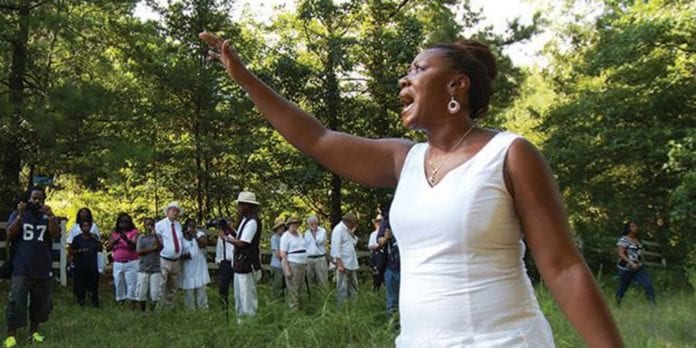
When you think of lynching, you think of it as part of America’s history, it’s not something you think of something as an occurrence in 2019. Jacqueline Olive’s new documentary, Always In Season looks at the lynching of African-Americans in history and ties it to today. Lennon Lacy was found hanging in August 2014, and stories circulated that maybe it wasn’t a suicide and maybe Lacy was the victim of a lynching. Olive read about the story and wanted to do something about it because she was a mother with a son who was the same age as Lacy. She reached out to Lacy’s mother and the story for Always in Season began.
I caught up with Olive to discuss Lennon Lacy, meeting with his mother and how the story had a personal impact on her. Always in Season is out today.
America has such an awful and tragic history with lynching. My biggest surprise as a Brit, moving here is watching the documentary and seeing this story about Lennon. How did you learn about his story?
When I learned about Lennon Lacy’s death, I’d already been filming for four years in communities where people were confronting historic lynchings. It was late July 2014, that I was actually at the point where I thought I was about to wrap production, but a month or so later, I read an article that said seventeen-year-old Lennon Lacy was found hanging from a swing set about a month later on August 29th. My son was the same age as Lennon, and I was so keenly aware of the fact that people who’d lost their family members to lynching generations ago are still traumatized by terrorism. I couldn’t imagine the level of grief that Lennon’s mother, Claudia Lacy, must be experiencing at just the suspicion that her child might have been lynched. I reached out because I wanted to understand better what happened and hear what Claudia and others in Bladenboro, NC, were dealing with. I ultimately began filming in there shortly afterward, and actually moved to North Carolina to be closer to filming, which I did for four more years.
I’m from Mississippi, and when I moved back home for a few years in the late 90’s and early 2000’s, I was aware of several similar cases of young black men found hanging publicly. Like Lennon’s, those cases were quickly ruled suicides, while family members were left without answers. So, the way that Lennon died was not unheard of for me. I was particularly tuned in, in 2014 as a filmmaker to his and Claudia’s story, because of the work I’d already begun doing, filming in about eight communities across the country where lynchings happened. There are truths about life in the United States, tragic and joyous, that people of color know that rarely make it into the mainstream, but their stories are no less essential and actually provide valuable insights into the complexities of this country.
You give the film great historical context, linking the past and the present, can you talk about your research?
From 2008-2010, I researched historic lynchings, starting with the collection of photographs and postcards called Without Sanctuary: Lynching Photography in America. Those images showed black men, women, and children mutilated and murdered, often with contented white men, women, and children posing with their bodies. When I saw those images, I was struck for the first time that the victims were people who very likely had loved ones impacted by their deaths. Neighbors would have cared about them. Others likely worked alongside them. Like a lot of people, prior to the research, I only thought of lynching victims vaguely as anonymous black men hanging. Again, I’m from Mississippi and was aware of the brutality, but from secondary school to graduate school, it was never required or encouraged to study this history. Dozens of images from Without Sanctuarymade it clear for the first time that the victims were a part of communities profoundly traumatized by the violence, that the scope of the terrorism, from Oregon and Minnesota to Illinois and Florida, was enormous, and that white people did not escape the fallout even when they showed up to cheer the violence on. So, I spoke with scholars, writers, and journalists as I researched the history to better understand everyone’s perspectives in the stories, and when I learned that there were people on the ground confronting this history, remembering the victims, and working to repair the damage, like the lynching reenactors featured in the film, I saw my way into the narrative and began filming.
Watching Claudia is heartbreaking, you hear a mother’s story, a determination for the truth. Mothers always know. What was it like sitting down with her, talking to her and hearing her story?
It was as heartbreaking as you can imagine. Claudia and Lennon were close because he was her last child, so they had a bond that was special. I saw that immediately and again thought of my son. I admired Claudia’s courage and determination to find answers so soon after Lennon’s death, and it’s a mission that still drives her, which, I think, helps her grieve. What I didn’t expect, is Claudia’s openness. She did not just give me access to her personal story, but Claudia’s heart was open to me and other people. She deeply cares about her community, despite the worst. As a filmmaker, I worked to show the complexities of her story. What must it be like to continue moving through your days working and caring for your grandchildren, all the while suspecting that someone lynched your child? Those were the kind of questions I wanted to explore, in addition to the evidence in Lennon’s case.
The film was almost a decade in the making, can you talk a little about that process, but also how news stories such as Ferguson impacting the filmmaking process.
After filming the last narration of lynching documents with Danny Glover in 2018 (and eight years in production), we wrapped production, and lead editor, Don Bernier, and I continued the hard work of structuring the narrative. Don is a brilliant editor and wonderful to work with, and those last few months of the edit were some of the most creative and exciting times of my life. It was always important for me to mirror the scope of lynching terrorism by combining stories about the impact in multiple communities. So, a quirky film about the lynching reenactment or a documentary about the single incident in Bladenboro wouldn’t help viewers to appreciate how unpacking lynching is critical to ending racial violence today. Lynching was thousands of incidences of seminal violence that lasted for generations out of a culture of dehumanization and terror. That’s the story I worked to tell, and it was an enormous challenge.
At the same time that I was making a film, I was raising my son and managing all that goes with being a mother. He was ten years old when I began researching and developing the project, and twenty when the film premiered at Sundance. Add to parenting the emotional toll of raising a black child in a country where adults and children who looked like him were being unjustifiably beaten, shot, and killed by police and vigilantes. I was also impacted by all of the racial violence, profiling, and structural racism that other Americans witnessed and faced during the decade I spent making Always in Season. The senseless deaths of Sandra Bland, Mike Brown, Renisha McBride, Jonathan Ferrell deeply disturbed me. Because I was deeply immersed in the history, I could see connections to the past that the country didn’t always anticipate. The cell phone videos of the police killings of Eric Garner and Philando Castile, for example, reminded me of the lynching photographs and postcards. They were still carried out despite common knowledge that the images would likely be recorded, and even with so many more videos in the public, officers continue to kill unarmed black and brown people with relative impunity.
You use reenactments which are striking. Can you delve into that a bit and the decision to use reenactments?
For three years before learning of Lennon’s death, I filmed in Monroe, Georgia (about 30 miles outside of Atlanta) with a diverse group of people who annually reenact the 1946 lynching of two couples, the Malcoms and the Dorseys. The reenactors often have little to no acting experience and have dramatized that lynching since 1946 to ensure that the nation never forgets the victims. They also work to get people to come forward with information about who was involved. The power of the reenactment is that they happen on the spot where the violence took place, immersing the crowds that come to watch, in history. I wanted this creative way of seeking to repair the damage of racial violence to be a part of the film because even when flawed, it’s important that audiences see the work that people, in communities like Monroe, are doing for justice and reconciliation that comes out of an organic need to tell their stories and help bring healing.
There’s a pain to watching this, almost an anger, but then you see Claudia and you feel the need to want to do something. How did making this change you personally?
I love filmmaking, and documentary, in particular, is such an undertaking of creativity, collaboration, entrepreneurship, and scholarship that if you approach the process with openness and commitment–it inevitably changes you. I’m an even more introspective person than I was ten years ago. Who knew that was possible! Also, compassion is generally at the forefront of my interactions with other people because I’ve met so many people who are deeply hurt, angry, fearful, and ashamed around all of the issues that come with more than a century of lynching terrorism. We can’t heal as a country by continuing to silence and dehumanize each other.
Over the past ten years, I’ve learned more clearly how to channel my own anger at the injustices into making the film, along with the joy and hope I encountered. I could make a film about anything, and who knows where my next projects will take me, but Always in Season is a part of my work of repair. I hope that the power of Claudia’s courage and love inspires audiences to unpack lynching terrorism, even in the face of emotional discomfort, and more deeply explore the many ways they can work to make the institutions right where they live equitable and just.