


The re-recording mixer talks about his process of layering sound for the Amazon comedy.
The Marvelous Mrs. Maisel is a huge project in every sense. From the costumes to the production design, Maisel is on a Mad Men level of specificity and craft—this one just makes you laugh a heck of a lot more. In addition to the show having a detailed look, it also sounds great. Ron Bochar is the man that makes sure you hear every single word that comes out of Midge’s mouth while she’s on stage.
New York City is a busy place, but we hear everything. The layering of sound on Maisel is staggering—just close your eyes when the characters are zipping around a busy restaurant or in The Gaslight, and you will get a sense of how difficult Bochar’s job is. He even revealed just how involved creator Amy Sherman-Palladino is to taking us back in time. A previous Emmy winner, Bochar deserves another statue for ensuring that we never miss a single syllable.
Awards Daily: You won an Emmy for Angels in America. How does it feel to be thrown back into it all?
Ron Bochar: I’m always up for a party. I didn’t think about the competition at all during Angels, and I want to do the same thing here. You don’t try to get wrapped up in that part of it. It’s not healthy.
AD: Just gotta enjoy the ride, right?
RB: That’s how I like to think about it, yeah.
AD: Can you walk us through your process after you’ve received a cut of Maisel?
RB: What normally happens is sometimes I get the episode before we spot. A lot of times I spot while they are storing up a few edits, so they don’t turn it over until they are really ready. I have refused to read any of the scripts because I want to be surprised with every episode.
AD: Oh really?
RB: I do that because I want the images to be fresh, if that makes any sense. Reading the script ahead of time doesn’t really help me at the end of the day. We have some oil derricks in the upcoming season, and I could’ve read it in the script. They’re all visual effects. They ain’t helping me! We have a spotting session and at that point the picture department has already gone through and already come up with a list of looping that they might need for sound effects in their cut. It’s more of a general discussion. A lot of times they show me a scene that is completely zany—like the scene in the Catskills when the family is first showing up at the summer house.
AD: When the camera sits and you’re looking all over the place.
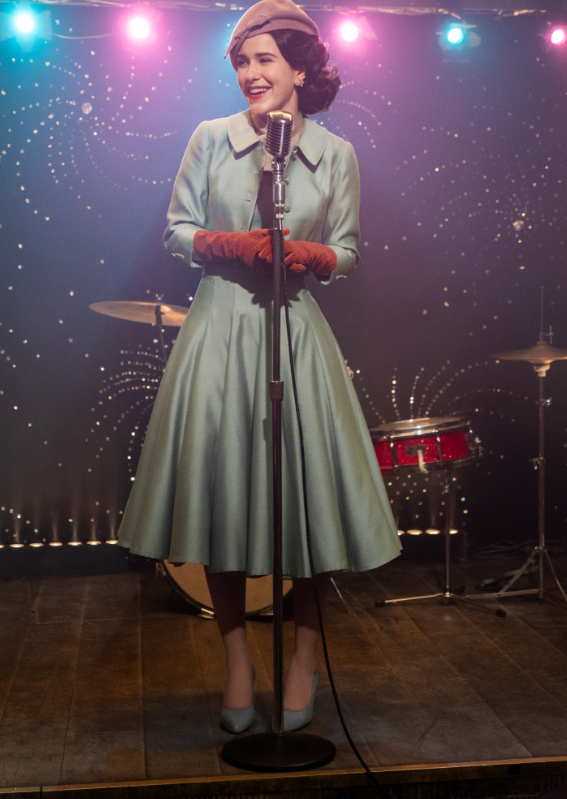
RB: It’s like a Robert Altman movie. They’ll have it kind of set up and presenting it to me with volumes all over the place, and Amy will turn to me and say, ‘Good luck!’ That’s how the spotting will go some of the times. She will be specific when it comes to the performances where we can get into this thing of Midge is warming up the crowd, they won’t laugh as much. Or ‘This joke is more for the women in the crowd.’
Amy is very specific in how she wants those to work out. In the process of the spotting session, we will get that sort of worked out. I basically send that information out to my crew. My dialogue editor, Sara Stern, works with the ADR editor, Ruth Hernandez, to try and attack all the technical aspects that are brought up with looping. Even performance-wise. Our goal is to come up with a production alternate that maybe they didn’t try or use that could fix any problem they could’ve had. You sometimes find out that there is a problem with a performance because, say, Midge isn’t projecting loud enough or Abe sounds kind of flubby here. As soon as we get into the tracks, which are pretty damn awesome, we try to make it sound more awesome. The first pass is to figure out what we can fix, and then they prep it for me on the way to the mix. You’ve seen the show. It’s like someone is firing a word machine gun for the entire show. They are 80-page scripts.
AD: Oh my God…
RB: And that’s crammed into 50 minutes. Rarely is anything dropped.
AD: I had no idea. That’s insane.
RB: It is insane! It’s not like they are speeding up that film. It’s how they do it on set. When I’m mixing, I need to make sure there’s as much clarity as possible. I’m constantly combining mics together to get the best fidelity of what Matt Price recorded. He’s been doing a great job this entire time. It just gives me life.
AD: Since it’s all about timing, and Amy is known for her specific writing style, the words are everything. It reminded me that you were nominated for an Oscar for Moneyball, and Aaron Sorkin is the same way. Everything starts with the words. Do you find similarities there? Do you look for writers like that?
RB: As long as I can make it so everything is heard, I can do everything that Maisel is capable of. Amy wants sound and she wants it to be as active and as busy as possible. She doesn’t ever to have a hold fill up, and she wants it to feel like a feature that is on adrenaline. It needs to be active.
AD: I was re-watching ‘Vote for Kennedy, Vote for Kennedy,’ and I closed my eyes at the top of the episode just to focus on the sound. In that diner scene, I could hear layered clinking of the glasses and all the dialogue there.
RB: That scene was wonderful to orchestrate. There were so many rhythms that were there by themselves, and we explore that with foleys. People getting in and out of chairs and putting glasses down and picking them back up. Suddenly, there would be a walk-by. All that kind of stuff helped us build further rhythms. There were already rhythms, but we built more. It’s great. Amy lets us do this.
After my editors do their work, Amy and Dan [Palladino] come in to review that. They haven’t heard it all together until they come in, and they leave me with a day’s worth of notes. Little things they want to do differently. Sometimes it’s radically different than when it was looked at the first time, so maybe they want to try something different. With any kind of stand-up, Amy is very specific with how that audience reacts, so I get one more complete pass on it. ‘There are too many laughs here’ or ‘Make it go out with some titters there’ and those notes are great for us because I know exactly what she’s talking about. They do another pass with me after I apply those notes. They make sure the music is right and then they never come back to it.
AD: I had no idea she was involved with even the sound.
RB: She’s all over it. And from what I hear on production, she’s the same way. Her and Dan even pick the music. Our goal is to present the ’50s and ’60s with ambiance. Beyond that, they aren’t out being too authentic. They are making sure the story is being supported by even the sound. If a ’60s car goes by, it has to be a ’60s car.
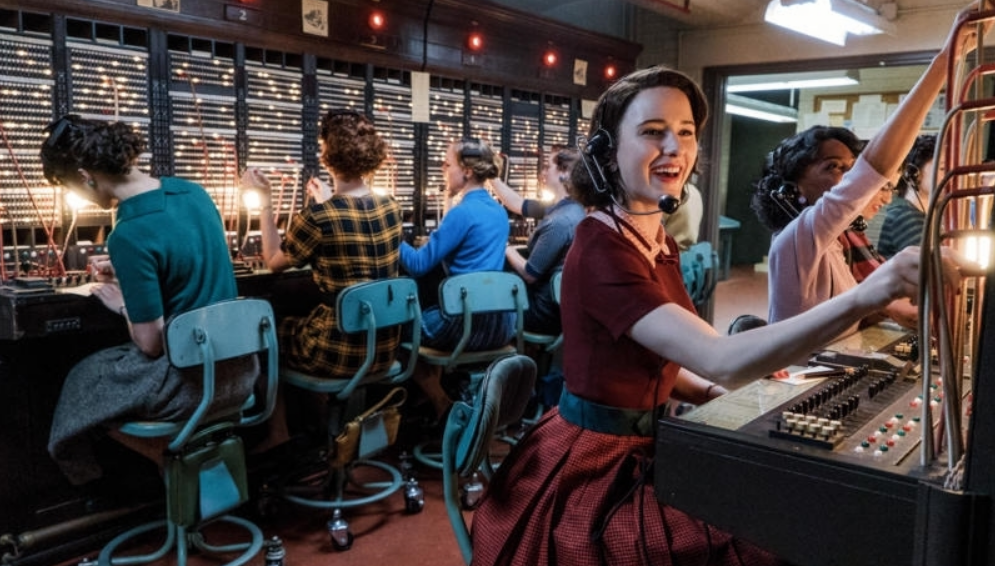
AD: As a contrast to a lot of sound—like the telethon sequences or even when Alex Borstein keeps bursting into the control room—is silence equally important? There are two scenes that I think about—the scene between Abe and Simon and then between Susie and Jane Lynch’s character.
RB: For me, day one of being a sound mixer, the hardest thing to justify are those silences. You have to have so much going on for that dynamic to take place. Silence is the underlying of everything. It’s making sure you know it’s important. It’s very dramatic. Amy and Dan will build the chaos and then bring it down to where everything stops. We never put silence in the film—I don’t think there’s a spot where I’ve been told, ‘Give me something here!’ Even that scene with Jane and Alex.
AD: I was thinking of how her voice translates in contract with Alex’s in that scene.
RB: Jane is slower and softer.
AD: What are you looking forward to with Maisel in Season 3?
RB: This is a coming of age. For me, it’s how does Midge leave New York and go out into the broader world? How does open space affect that? In New York, everything is clustered together; even in the Catskills scenes, there are kind of four walls. I’m curious to where that’s going to leave with her.