

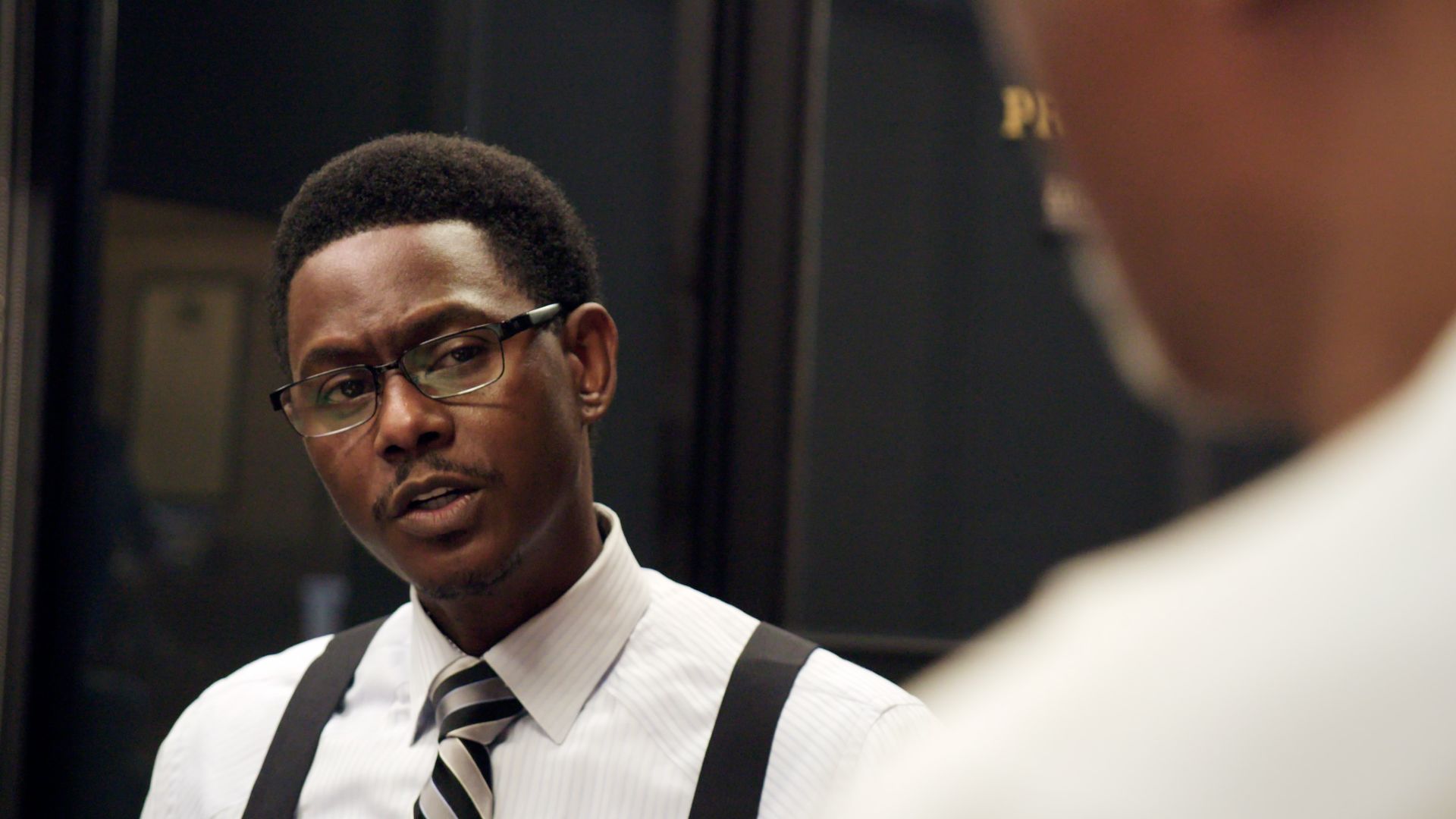
Feeling like nobody believes in you can cause overwhelming emotional stress. Imagine creating a presentation to get a loan at a bank, but their representatives, from the get-go, don’t appear interested or seem as if they are even going to extend a real chance to your proposal. Admitting that you need help is harder than we admit to ourselves sometimes. Christine Turner and John Hoffman’s captivating and confident documentary short, The Barber of Little Rock, honors Arlo Washington, a barber and professor who saw how underserved his community was and decided to do something about it. This film is a true call to action.
Some people in the audience might not ever have heard the phrase racial wealth gap, so that presented the directors with a unique challenge from the very beginning. With exhilarating candor, Barber mingles together the explanation of this uniquely American problem with the introduction of Washington himself. Closing the economic gap he faces will take a lot of effort from a lot of people from different backgrounds, but Hoffman and Turner knew they needed to introduce the root of the problem to anyone uniformed in the audience as the first step to understanding the obstacles.
“Christine and I wanted to make a film about this seemingly insurmountable topic and substantial problem,” Hoffman begins. “We didn’t where to start in terms of making a documentary. You do what you normally do with reading and talking with people and we were pointed to The Color of Money: Black Banks and the Racial Wealth Gap by Mehrsa Baradaran. It’s about the history about Black banking in this country since The Reconstruction Era, and it makes the argument, for all intents and purposes, one series of failed government policy after the other. This is a structural problem that is not improving because our government won’t correct them–except for Bill Clinton making the CDFI program. [With Community Development Financial Institutions, Clinton had] this understanding of how the access to capital is possible for huge swaths of the country. It might be people in rural areas but urban communities that have been systemically cut out of the financial systems, and you have to approach this with that in mind.
“The CDFI evaluates risk in a very, very different way, and if your evaluate that risk based on who people are instead of a credit score, you open up so many opportunities for people to get home loans or get a car. You are then changing opportunities and the health of the community. It’s such a well-written book, and you see that there is this one thing that she is pointing to in hundreds of years. After that, you learn about the rich history and the whole culture that is so rich on a filmmaking standpoint. No one had brought cameras into these CDFIs. A friend told us that Clinton did a Zoom conversation with Donna Gambrell, who was the first administrator of the CDFI program forty years ago, and she is now the president of the National Association of Black Bankers. She pointed us to Arlo Washington, and we knew we had to meet this guy.”
In order to speak to each other about this gap, we need to be honest with one another. There are several moments where we meet Arlo Washington in his car, and it feels like he is even realer with us once we are in such close quarters with him. Turner and Hoffman truly capture Washington’s easy-going, personal charisma. Because he is such a genuine listener, we become better listeners ourselves.
“Arlo is an incredible listener, and that’s one of the reasons why we were so drawn to him,” Turner explains. “In a day-to-day way, he is moving between the barber college, the shipping container loan fund, and the brick-and-mortar loan fund and, eventually, this credit union. He is addressing the various needs throughout all these phases simultaneously, but he gives everyone he encounters his time. Truly, he does listen. That was exciting for us to move between the different spaces to see the different kinds of interactions all the time and how he responds. It speaks to the needs of the community and how much he and his team are trying to address the struggles and crises.”
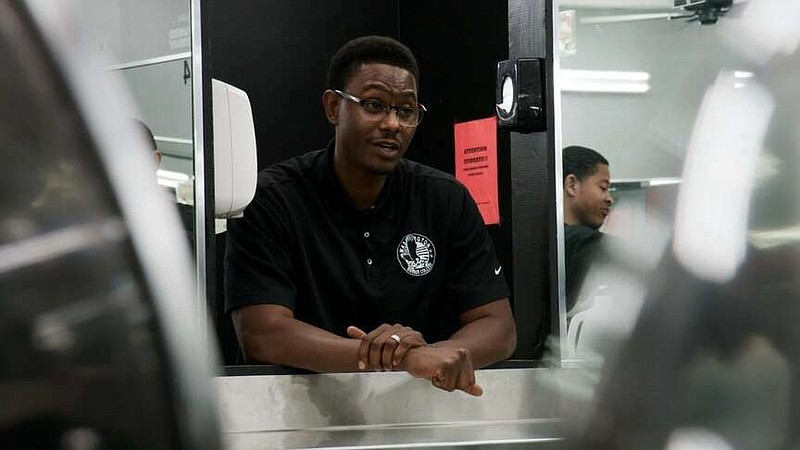
“Because he is moving between these spaces and we were moving with him, we started shooting with Tony Hardmon, our amazing DP, to travel with Arlo,” Hoffman says. “The first few times, neither Christine or myself got in the car, but Tony told us that we needed to hear what he would talk about when we were on the road. From that point on, we never got in a car without a camera. You hope, when you’re making a film, that you don’t have to do formal interviews–you don’t know what is going to happen–but Arlo is such a natural historian. He grew up in Little Rock, and he will point out where he lived when he was four years old, for instance. And there would be a story to follow that.”
We keep coming back to the barbershop school time and time again through Barber, and it really emulates how work constantly needs to be done. Hoffman and Turner, of course, brought us back since so much of Washington’s work is based in his trade, but it’s a great visual cornerstone to return to.
“Arlo is there quite a bit, so it’s a space that we returned to quite frequently,” Turner says. “We were excited, initially, by his work as a barber and by how he ran the college. There is such a rich history there to be told. He talks about how the barber has played a key role in the Black community, and we see how, for him, his role has continued to broaden in the community. In an organic way, he came into running this loan fund–he doesn’t have this finance background. That was thrilling for us to watch. Conversations were happening at the barber college and it’s where we were led back there constantly. We met a lot of people that we filmed with there as well.
In the film’s most breathtaking sequence, Washington has a group of men perform an exercise where they stand toe-to-toe and stare into each other’s eyes. ‘I want you to be with him,’ Washington tells these men, and there’s no machismo present. No bravado. Washington’s teachings are not just about asking how to get a loan in a more effective manner, but, instead, he insists on asking people to look within themselves in order to connect with their fellow man. It is one of the most honest moments in any documentary featured this season.
“One of the most powerful moments is when the two men are staring at each other,” Hoffman says. “You’re hiding in a corner with a monitor, and you don’t know what’s going to happen next. It was one of those moments that you needed to include, but I think it’s so important because it’s deepening the understanding of how committed Arlo is to people’s success. Success is not a diploma or a loan–it’s really [about] becoming as strong as they can be as individuals. Men, in so many ways, are not taught how to empower themselves, and that scene is Arlo’s understanding that part of what he is doing is not just the physical skill but the emotional ones. When he talks about connecting with the client, it’s all about looking them in the eyes. We all understand from immersing ourselves in Black barbershops that it’s a great place for storytelling, and it’s about the relationship with the barber. If a person isn’t communicating with their eyes, then they aren’t going to develop that relationship with a client that’s returning and returning and returning. That’s so much about what Arlo is thinking about. It’s not just about technical skills. I am very proud of that moment in the film, and I think Arlo is working on so much in that Black community.”
 “His work is really holistic, I think,” Tuner adds. “I think it’s rare to see vulnerability captured on screen with Black men, in particular. To have been present and capture it in authentic way is a rarity, and I don’t think we see a lot of representations of that. That’s why it’s so affecting–it doesn’t matter who you are. It speaks to how Arlo carries out his work.”
Towards the end of the film, we are back in Washington’s car, and his passenger tells him, “This is about being free.” This is after we have seen how bank loans are dispersed through Little Rock and after Washington opens up to the struggles he faced within his own family. Barber activates something within us all.
“In the simplest terms, there’s more work to be done,” Turner says. “Here is a guy who has found a way to lift up his community around him and address this huge racial wealth gap, or, as it’s referred to in the film, a chasm. It’s not he alone to fix the gap, but Arlo is a clear example of somebody working to address it. Certainly, we hope it riles people up, and Arlo shows us how it can be done. It’s part of the larger project.”
“The reason I do what I do is to change people’s hearts and minds,” Hoffman says. “We work in an artform that can be emotionally powerful, so that’s the privilege we have in doing this for a living. You can open up conversations. Something we have heard is how it’s changed how people think. In Indianapolis, the film premiere to a primarily white audience at IndyShorts, and Arlo was there with his wife. It was such a wonderful crowd. At the Q&A, a white man stood up and told us that he had heard about the racial wealth gap before, but now he understood. That kind of honesty of a man revealing his failings…we can’t ask for a better reaction from an audience. The exact same thing happened at Woodstock. It was uncanny. Now that The New Yorker is presenting it on YouTube, the barrier is having Wi-Fi.”
The Barber of Little Rock is streaming now via The New Yorker’s YouTube Page. We have linked the film below. If you would like to see Barber and the other four nominated documentaries in this category, ShortsTV’s presentation of the nominated shorts is in theaters now.